The EU Battery Passport, explained
From 18 February 2027, every EV battery, LMT battery (e-bikes, scooters) and industrial battery above 2 kWh placed on the EU market must carry a Battery Passport — a machine-readable record reachable from a QR code on the battery. Here is what it must contain, who is responsible, and how dpp.gs produces it.
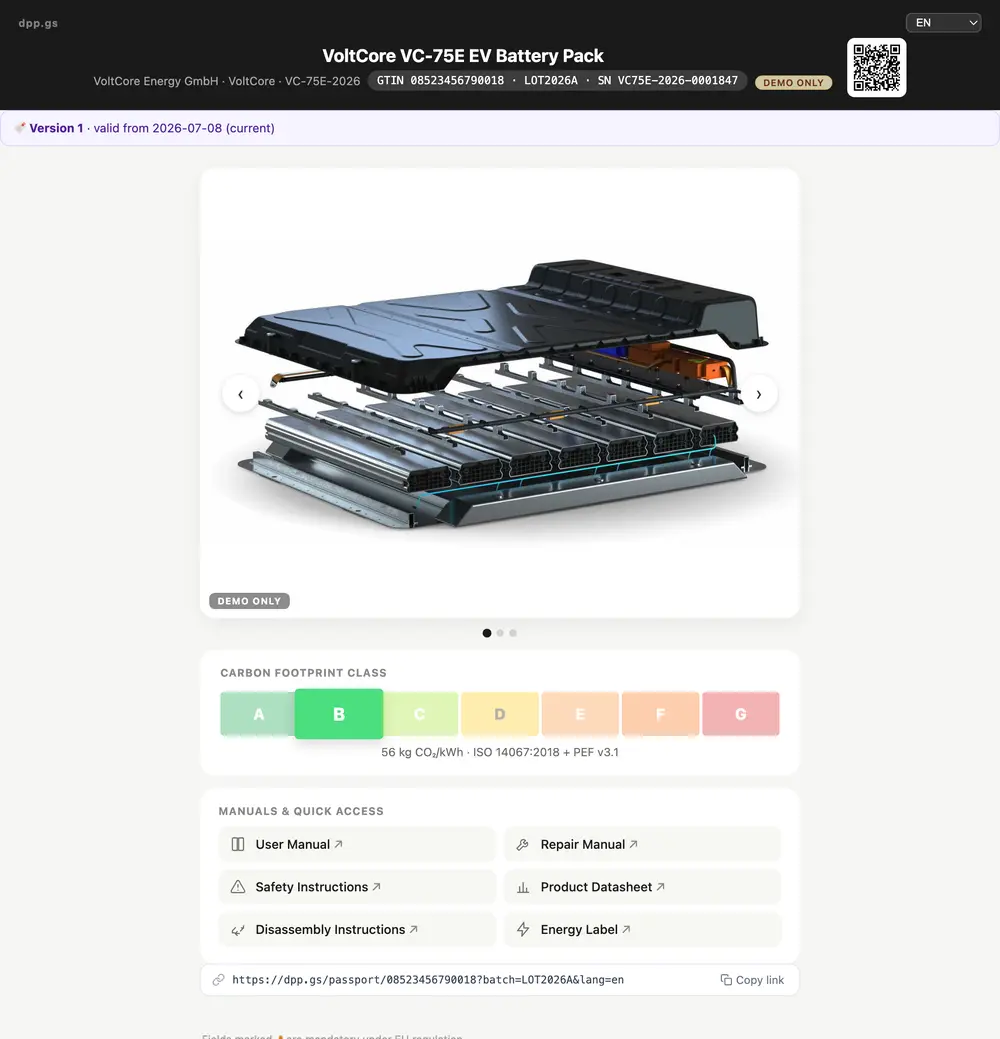
What the Battery Passport is
The Battery Passport is the product-level digital record mandated by the EU Battery Regulation (EU) 2023/1542. Each battery in scope carries a unique identifier encoded in a QR code; scanning it opens the passport with the battery's technical, environmental and supply-chain data. It is the battery-specific forerunner of the wider Digital Product Passport under ESPR.
Who needs it, and from when
- 18 February 2027 — mandatory for EV batteries, LMT batteries (light means of transport — e-bikes, scooters) and industrial batteries > 2 kWh.
- The obligation falls on the economic operator placing the battery on the market (manufacturer, importer or authorised representative).
- Carbon-footprint and recycled-content thresholds phase in through Commission delegated acts.
What data it must carry (Annex XIII)
Annex XIII lists the mandatory data set. In practice it groups into:
| Area | Examples |
|---|---|
| Identification & general | Manufacturer, battery model, category, weight, date placed on market |
| Performance & durability | Rated capacity, expected lifetime, internal resistance, round-trip efficiency |
| Composition | Chemistry, critical raw materials, hazardous substances |
| Carbon footprint | Lifecycle CO₂e and performance class (A–G) |
| Recycled content | Cobalt, lithium, nickel, lead — recovered share |
| Circularity & safety | Disassembly information, safety data, end-of-life instructions |
| Due diligence | Supply-chain due-diligence report (Art. 48) |
Some fields are public, others are visible only to authorised parties (notified bodies, market surveillance, recyclers). The passport must also expose live state-of-health (SoH) for the battery's whole life via an accessible interface (Art. 14).
How dpp.gs delivers it
dpp.gs has a dedicated Battery Regulation 2023/1542 — Annex XIII section built into the product editor, so a compliant passport is data entry, not development:
- Per-unit passports with a live SoH / BMS API endpoint (Art. 14) and a lifecycle audit trail.
- Carbon footprint captured with the A–G performance class; recycled-content verification per material.
- Materials & critical raw materials, hazardous substances, and step-by-step disassembly information.
- Role-segregated visibility (consumer / recycler / authority) and a generated Declaration of Conformity.
- GS1 Digital Link QR + GS1 DataMatrix, and EPR export (CSV / JSON / Asekol / MŽP SR) for producer-responsibility reporting.
Battery-ready in an afternoon
Create a full Annex XIII battery passport on dpp.gs — no engineering required.
Get started