What Is the EU Digital Product Passport? Complete Guide for 2027
The European Union is introducing mandatory Digital Product Passports (DPP) for products sold in the EU. Here's everything you need to know: what it is, who needs it, when, and how to get compliant.
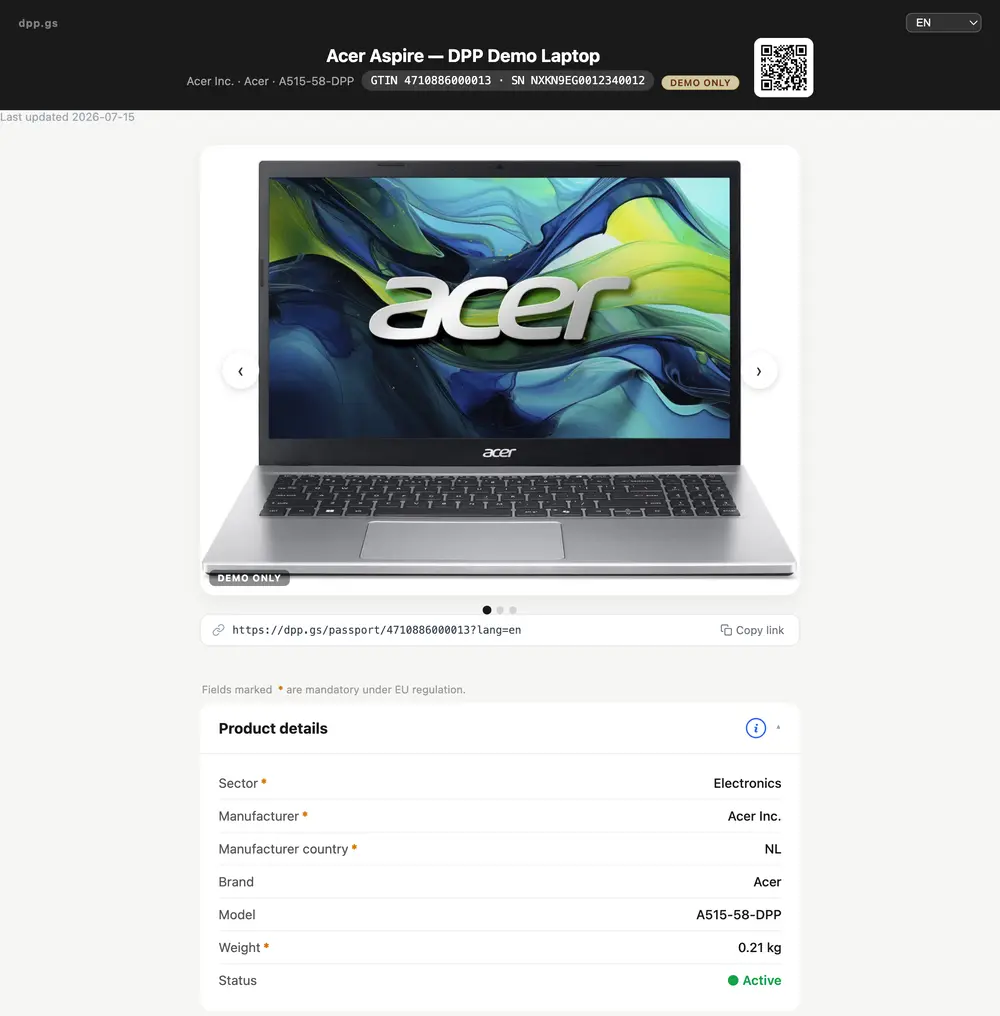
What is a Digital Product Passport?
A Digital Product Passport (DPP) is a digital record that contains information about a product's origin, composition, repair, and recycling options. It's accessed via a QR code or DataMatrix code on the product, which links to a standardized data set.
The DPP is part of the EU's Ecodesign for Sustainable Products Regulation (ESPR), adopted as Regulation (EU) 2024/1781. Its goal is to make products more sustainable, repairable, and recyclable by providing transparent data throughout the product lifecycle.
Who needs a Digital Product Passport?
If you place products on the EU market, you need a DPP. This includes:
- EU manufacturers producing goods sold within the EU
- EU importers bringing products from non-EU countries (China, India, Turkey, Vietnam, etc.)
- Brand owners selling under their own brand via Amazon, Alibaba, Temu, or other marketplaces
- Authorized representatives acting on behalf of non-EU manufacturers
Important: Under ESPR, the importer is legally responsible for the DPP — not the manufacturer. If your supplier is in China and you import into the EU, the obligation is yours.
Mandatory deadlines
| Date | Sector | Status |
|---|---|---|
| February 2027 | EV batteries & industrial batteries (≥2kWh) | Mandatory |
| July 2027 | Textiles & apparel | Mandatory |
| 2028 | Electronics & ICT equipment | Expected |
| 2029 | Furniture & construction products | Expected |
| 2030 | All remaining product categories | Expected |
What data does a DPP contain?
The exact requirements vary by product category, but generally include:
Core ESPR fields
- Product identification: GTIN, batch/lot number, serial number, product name, brand
- Manufacturer & importer: Name, address, country, contact
- Material composition: Materials, percentages, country of origin
- Carbon footprint: Total CO2, manufacturing, transport, use, end-of-life
- Recycled content: Pre-consumer, post-consumer, renewable content
- Repairability: Score, spare parts availability, disassembly time
- Compliance: CE marking, REACH, RoHS, energy efficiency
- End of life: Waste code, recycling instructions, disassembly guide
- Documents: Declaration of conformity, technical docs, safety instructions
Battery Passport additional fields (EU 2023/1542)
- Battery chemistry, capacity (kWh/mAh), voltage, cycle life
- Temperature ranges (operating and storage)
- Cell composition: cathode, anode, electrolyte materials
- Critical raw materials: lithium, cobalt, nickel, manganese content
- Carbon intensity (kg CO2/kWh)
- Recycled material targets: cobalt ≥16%, lithium ≥6% (from 2031)
- UN transport number, hazmat classification
- Supply chain due diligence report
How is the DPP accessed?
The DPP must be accessible via a GS1 Digital Link encoded in a QR code or DataMatrix code on the product or its packaging. When scanned, it opens a webpage showing the product data in the user's language.
The GS1 Digital Link URI follows this format:
https://resolver.example/01/{GTIN}/10/{batch}/21/{serial}
Where 01 is the GTIN Application Identifier, 10 is batch/lot, and 21 is serial number.
What are the penalties for non-compliance?
Products without a valid DPP will be:
- Blocked at EU customs — they cannot enter the market
- Removed from online marketplaces — Amazon, eBay, and others must verify compliance
- Subject to fines — determined by each EU member state, potentially significant
- Subject to product recalls — if already on the market without DPP
How to create a Digital Product Passport
There are three approaches:
- Build your own system — requires GS1 Digital Link resolver, database, multilingual viewer (months of development)
- Hire a consultant — expensive, slow, ongoing dependency
- Use a self-service platform like dpp.gs — live in 5 minutes, free to start
Create your first Digital Product Passport in 5 minutes
dpp.gs is a self-service DPP platform. GS1 Digital Link conformant, 25 EU languages, CSV batch upload.
Get started — no credit cardKey regulations
- ESPR 2024/1781 — Ecodesign for Sustainable Products Regulation (main DPP framework)
- EU 2023/1542 — Battery Regulation (Battery Passport requirements)
- REACH (EC) 1907/2006 — Chemical substances registration
- RoHS 2011/65/EU — Restriction of hazardous substances
- GS1 Digital Link Standard — QR code and resolver standard for DPP
Frequently asked questions
Do I need a DPP if I only sell on Amazon?
Yes. Online marketplaces operating in the EU must ensure products have valid DPPs. Amazon, eBay, Alibaba, Temu, and Shein will all need to verify DPP compliance.
I'm a Chinese manufacturer exporting to the EU. Is this my responsibility?
Legally, the EU importer is responsible. However, if you want to remain competitive, providing DPP-ready data to your EU customers gives you an advantage. Many importers will choose suppliers who already have DPPs.
How much does it cost?
With dpp.gs, you can start free (2 GTINs). Enterprise pricing is available for large volumes.
What is GS1 Digital Link?
GS1 Digital Link is an international standard that encodes product identifiers (like GTINs) into QR codes. When scanned, the QR code resolves to product information. It's the required format for EU Digital Product Passports and is also used in the US (GS1 Sunrise 2027).
Can I use a DataMatrix instead of a QR code?
Depends on your sector. ESPR permits both; Battery Regulation Annex VI explicitly mandates QR. See our dedicated guide: QR Code vs GS1 DataMatrix for DPP.
Ready to get compliant?
See a live Digital Product Passport example, then create your own.
See live demo